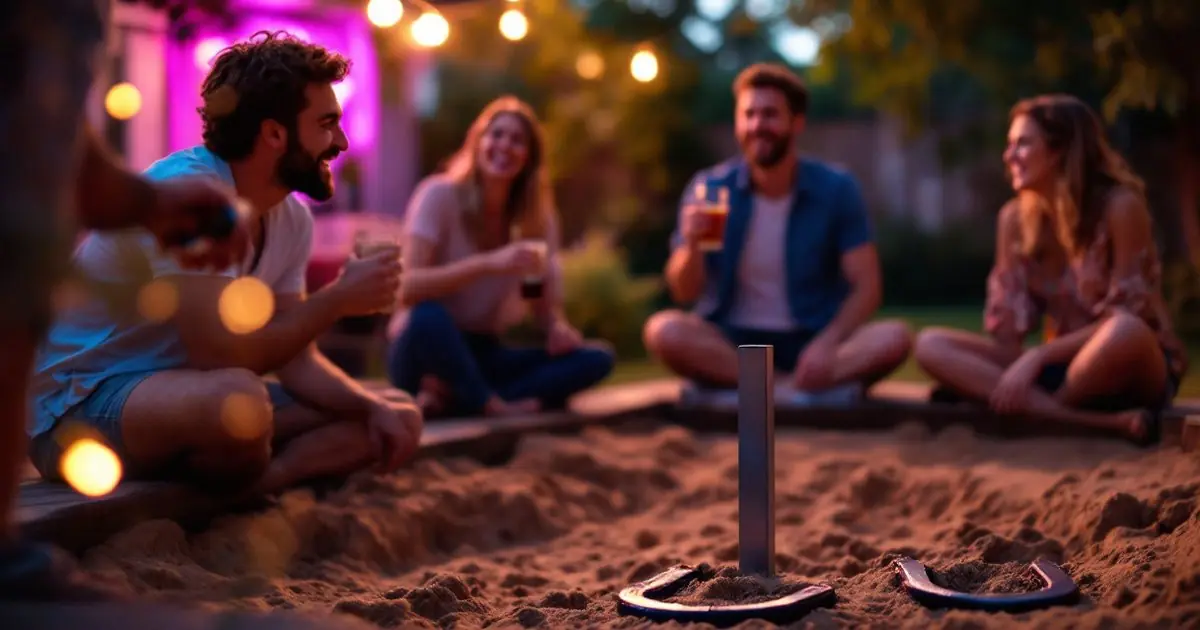
Horseshoes is the classic backyard and tailgate game where players toss metal horseshoes at a stake in the ground — ringers score 3 points and the competition is timeless.
Horseshoes is one of the oldest American outdoor games — it traces back to soldiers throwing actual horseshoes around camp stakes. Modern horseshoes are purpose-built and much more consistent, but the fundamentals haven't changed in a century.
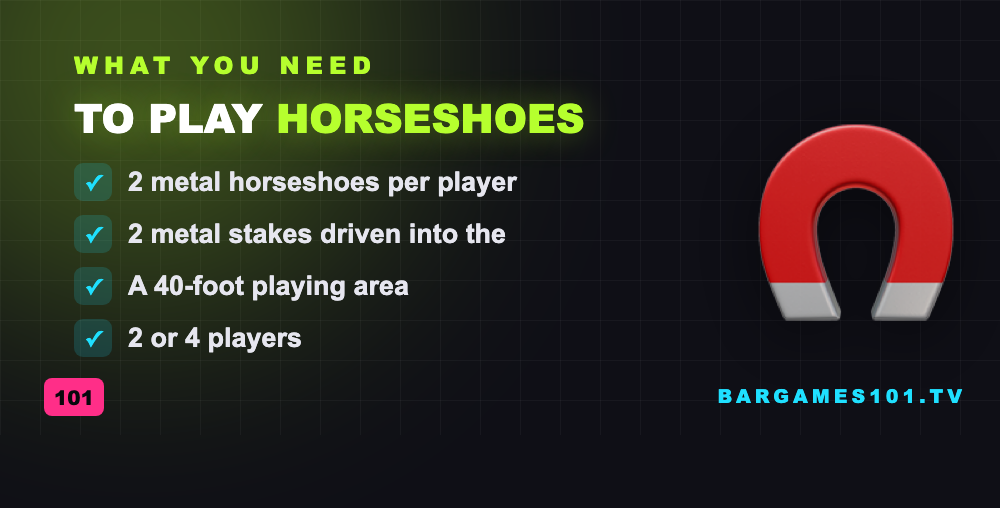
2 metal horseshoes per player (4 total for 2 players, 2 per team for doubles)
2 metal stakes driven into the ground
A 40-foot playing area (professional distance: 40 feet stake to stake)
2 or 4 players
Casual backyard horseshoes can be played at 30 feet (beginners) or even 20 feet for kids. Official rules are 40 feet apart.
Setup
Drive two metal stakes into the ground 40 feet apart. Stakes should be angled slightly toward each other (about 3 inches out of vertical) and should stick out of the ground approximately 14-15 inches. Many sets come with a portable stand for the stakes.
If using a pit, fill the area around each stake with sand or clay — 43 inches square and 4 inches deep per official rules. Backyard casual play doesn't require a pit.
Two players stand at opposite ends. In doubles, one player from each team stands at each stake.
How to Play
Throwing
Stand at one stake and throw toward the other. In official play, you stand in the "pitcher's box" (a 6x6 foot area surrounding the stake). Both feet must stay inside the box during the throw.
The standard throw: hold the horseshoe by the opening (the open end) with one or two fingers. Most players use a "one and a quarter" or "one and three-quarter" flip, meaning the horseshoe rotates 1.25 or 1.75 times in the air to arrive opening-first at the stake. Finding your flip is the skill that takes time.
Scoring
After both players have thrown both horseshoes, score the round:
Ringer: Horseshoe completely encircles the stake (a straight edge can touch both open ends and not contact the stake). Worth 3 points.
Closest to the stake: If no ringers, the horseshoe closest to the stake (within 6 inches) scores 1 point. Only the closest horseshoe scores.
Cancellation scoring: Ringers cancel each other out. If both players have a ringer, they cancel and no points are awarded. If one player has a ringer and the opponent doesn't, the ringer player scores 3 and the opponent scores 0.
Leaner: A horseshoe leaning against the stake counts as closest-to — it's not a ringer but it scores if it's the nearest.
Innings
After scoring, players walk to the other end, pick up their shoes, and throw back. This completes one full "inning." Score accumulates.
Winning
First player or team to reach 21 points wins. In official tournament play, you must win by exactly 21 — hitting 21 means you win; going over means you stay at your current score before the overage.
Some casual rules say first to 21 or 40, no bust required. Agree before you start.
Tips & Strategy
Find your flip. Experiment with 1/4, 3/4, 1, 1.25, and 1.75 flips to find which lands reliably opening-first. This is the core skill and takes real practice.
Aim for the stake, not the pit. Your eye should lock on the stake. The horseshoe goes where you aim; aim for the metal, not the dirt.
Consistent grip and release. Like any throwing sport, grip and release point are everything. Lock them in and repeat exactly.
Cancellation awareness. If you're ahead and both you and your opponent are throwing ringers, the points cancel. Sometimes a strategic non-ringer is better than a cancelled ringer to preserve your lead.
Practice the approach. Your footwork on the approach to the pitcher's box affects your release. Develop a consistent number of steps and approach angle.
Variations
Backyard Casual (20-foot rule)
Move stakes to 20-25 feet for a more accessible game. Perfect for kids or beginners. Same scoring rules.
Washer Toss
Replace horseshoes and stakes with washers (large metal rings) and small boxes with holes. Same concept, more portable. Popular at tailgates.
Rubber Horseshoes
Soft rubber horseshoes are safer for younger players and indoor use. Scoring is the same. Distance is typically shorter.
Drinking Horseshoes
Opponent scores a ringer = you drink. You score 0 in a round = take a sip. Game ends = loser finishes their drink. Low-key and works well for a long outdoor session.
Drinking variation is intended for adults 21 and older. Please drink responsibly.